
From commitments to coordinated human–AI work.
ReliablyME helps people and teams make commitments and follow through. ReliablyWE builds on that foundation to connect agreements, assistance, evidence and acceptance across people, organizations and AI agents. Explore how the next generation is designed to make handoffs clearer, keep consequential decisions with people and distinguish a delivered result from an accepted outcome. ReliablyWE is in development. The examples illustrate the intended experience.
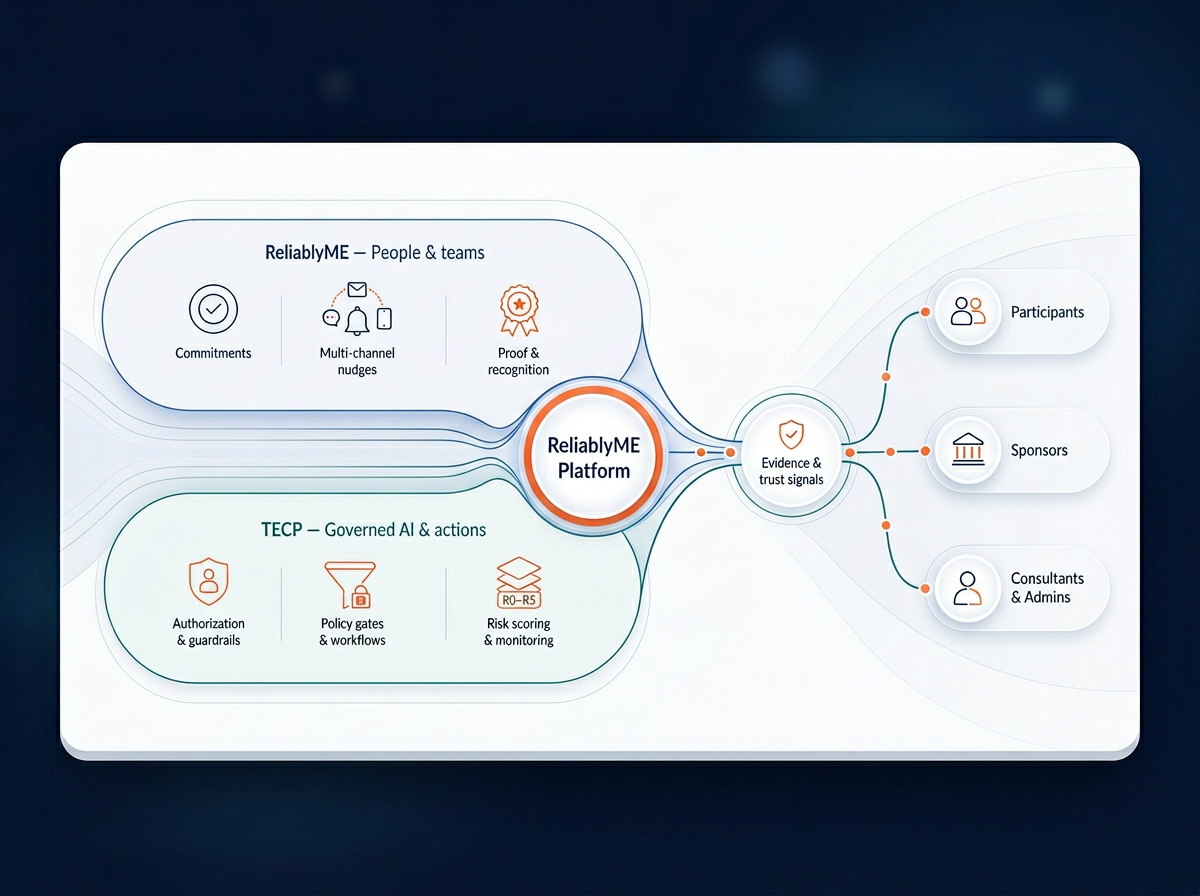
The foundation and the next generation
ReliablyME: the existing product. ReliablyME supports commitments and follow-through for people and teams, with evidence to help review what happened. This is the foundation—not simply another name for the company.
ReliablyWE: the next generation. ReliablyWE is being developed to connect the people involved in a workflow and their AI assistance through a shared agreement-to-acceptance journey. Its intended additions include help clarifying agreements, responding to changed conditions, coordinating work within the right authority, and connecting delivered evidence to an explicit review decision.
ReliablyME Inc. is the company behind both. Ari is the assistant in the ReliablyWE experience.
The distinction is an evolution in the collaboration experience, not a claim that the existing ReliablyME product lacks team or evidence capabilities.
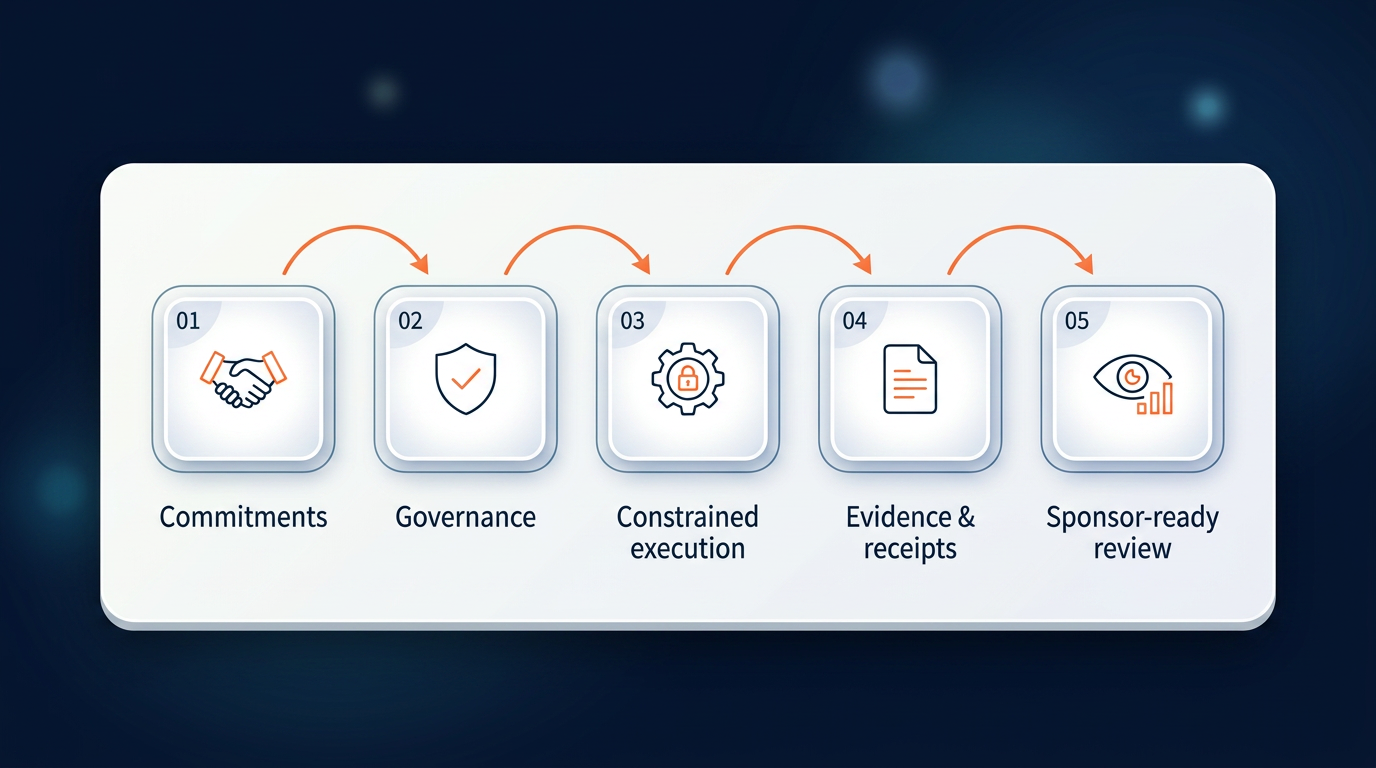
Intent → Authority → Commitment → Action → Evidence → Review → Outcome.
A customer needs a motor. People must clarify the request, agree responsibilities and decide what evidence is needed before the next handoff. In the fictional ReliablyWE story, technical review and permission to ship are separate decisions; delivery and confirmed receipt are separate events. This is the intended journey, not a receipt for a live customer deployment.
Intent
Follow-Through
What outcome is needed, and who depends on it?
An intended change surfaces from training, a workshop, an AI rollout, an audit finding, or an AI-assisted recommendation. Intent alone is not yet a commitment.
Authority
Follow-Through + TECP
Who may agree, decide or act—and within what limits?
Establish who is authorized to commit or to act, within what bounds. Authority must be legitimate, bounded, attributable, and revocable — a click alone is not meaningful control.
Commitment
Follow-Through
What did the relevant parties actually agree to, including timing and what counts as done?
A named person or team personally accepts a specific commitment, with an owner and a deadline. AI agents do not commit; they receive bounded, signed scope.
Action
Follow-Through + TECP
What happened, and what changed along the way?
People act in the flow of work with lightweight support. For consequential AI-agent actions, TECP is designed to enforce policy constraints at execution time.
Evidence
Follow-Through + TECP
What deliverable or information supports the claimed result?
Record what happened — observed facts, submitted evidence, calculated indicators, and, where TECP applies, durable execution receipts.
Review
Follow-Through + TECP
Who is authorized to assess it against the agreement?
An authorized human reviews the evidence, corrects the record where needed, and can revoke or escalate delegated authority.
Outcome
Follow-Through
Was it accepted, challenged or returned for more work—and what happens next?
Sponsor-ready proof packs leaders, auditors, and regulators can review — so the next decision rests on evidence rather than anecdote.
What Ari adds
Ari is designed to help people navigate the work, not simply mark tasks complete.
Clarify the agreement. Help the parties make responsibilities, dependencies, timing and acceptance criteria explicit.
Support follow-through. Help a participant understand a request, identify a blocker or revisit terms when conditions change.
Respect information boundaries. Keep private coaching distinct from information authorized for sharing with others in the workflow.
Bring the evidence together. Help the appropriate reviewer connect the delivered version and supporting evidence to the agreement.
Ari does not turn a suggestion into permission or a completion claim into acceptance. Consequential actions remain subject to the appropriate human authority.
See the evidence behind the status
A useful record lets someone judge the result rather than rely on a completed-task label.
Illustrative review record — fields shown, not a customer result
- Agreed outcome and responsible party
- What was promised, by whom and to whom
- Timing and acceptance criteria
- When it was due and what was agreed as sufficient
- Delivered artifact and version
- The exact work submitted for review
- Supporting evidence
- What supports the claim and what remains uncertain
- Review decision
- Who accepted, challenged or requested changes, and on what basis
- Remaining dependency and next step
- What still needs action and who owns it
A delivery receipt establishes that something was delivered. It does not by itself establish usefulness, effectiveness or acceptance.
Where this can matter
Operational handoffs: make it clearer what the next person needs, what has been agreed and what remains unresolved.
AI-assisted work: connect a useful AI contribution to the responsible people, permitted action and evidence needed for review.
Corrective-action follow-through: make the agreed change and the evidence of follow-through explicit, without treating an assigned action as proof of effectiveness.
These are application examples, not claims of ready-made integrations or regulatory suitability.
Architecture and detailed capabilities
The product experience brings commitments, assistance and evidence together. The technical detail below explains the underlying concepts and the capabilities associated with each product.
TECP—the Trust Enablement Control Plane—is the separate emerging control-layer work concerning permission for selected consequential AI actions. It is not another name for Ari or a substitute for the reviewer who judges a result.
These descriptions distinguish the ReliablyME foundation from emerging TECP work; they are not a single released ReliablyWE feature checklist.
The ReliablyME foundation and emerging TECP architecture
Follow-Through and TECP share one lifecycle but are at different stages. TECP is an architecture preview available for briefings. For any pilot, we confirm which capabilities are available, tested as prototypes or still planned before scope is agreed. Used together, they are intended to make human follow-through and AI execution visible, governable, and reviewable — without collapsing the two contracts into one. Only people and institutions commit and delegate authority.
ReliablyME Follow-Through
Capabilities and readiness are assessed for the named product and workflow.
For people and teams
- Commitments personally accepted by people and teams
- Channel-of-work follow-up and support
- Evidence recorded, corrected, and reviewed
- Sponsor-ready proof packs
TECP — Trust Enablement Control Plane
Emerging · architecture previewFor consequential AI-agent actions
- Designed for signed human authorization of each action
- Designed to enforce policy constraints at execution time
- Risk-tiered approval gates (R0 → R5) by design
- Durable execution receipts, revocation, and human review
TECP is the separate governed-execution layer. Available for architecture briefings. Any controlled implementation is scoped individually, with readiness to be verified for the specific version and use case.
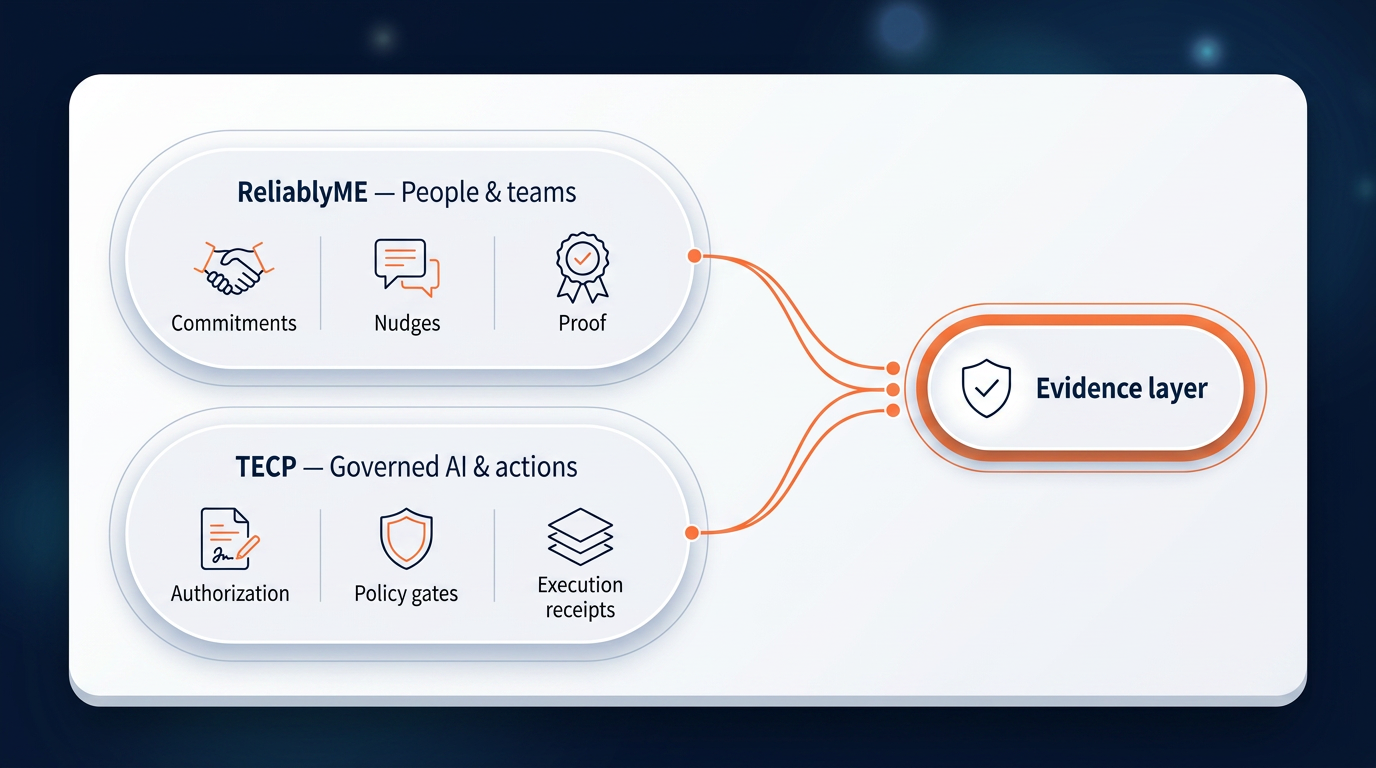
Five evidence categories for review
Reviewable outcomes depend on knowing exactly what kind of evidence you are looking at — and who, if anyone, decided.
Observed facts
What the system directly recorded — a response, a timestamp, a completed step.
Submitted evidence
What a person or team provided — a note, a photo, a confirmation, a reflection.
System-calculated indicators
Derived from recorded data. Descriptive coaching signals, never punitive scores.
AI-generated inferences and recommendations
Clearly labeled as suggestions. They are never decisions and carry no authority.
Human decisions
Attributable to a named, authorized person — the only category that carries authority.
Correction, revocation, and review
Records can be corrected, delegated authority can be revoked, and every consequential outcome can be escalated to a named human reviewer. Within TECP, revocation and review are part of the control plane by design — not an afterthought.
Proof packs turn follow-through into a decision asset.
A proof pack summarizes the evidence trail: commitments accepted, support delivered, actions completed, blockers surfaced, participant reflections, review decisions, and recommended next steps.
Capabilities and readiness are assessed for the named product and workflow.

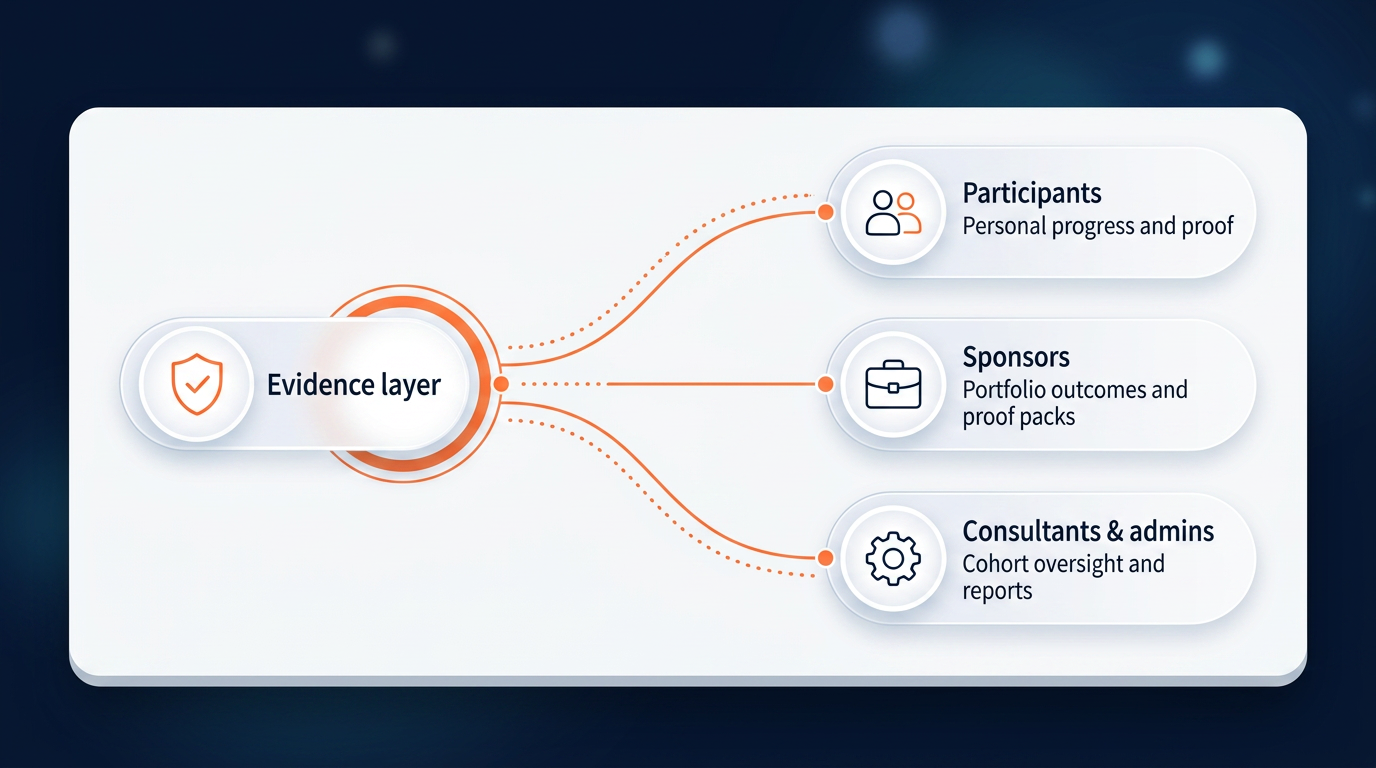
One evidence layer, three audiences.
Participants
Clear, respectful prompts in their channel of work
Commitments they accepted, supportive follow-ups, and confirmation prompts.
Sponsors
Evidence that the program changed how work happens
Proof packs, blocker visibility, and completion trends.
Consultants & admins
A repeatable delivery model
Templates, cohorts, progress indicators, and reports.
Embedded in the tools teams already use.
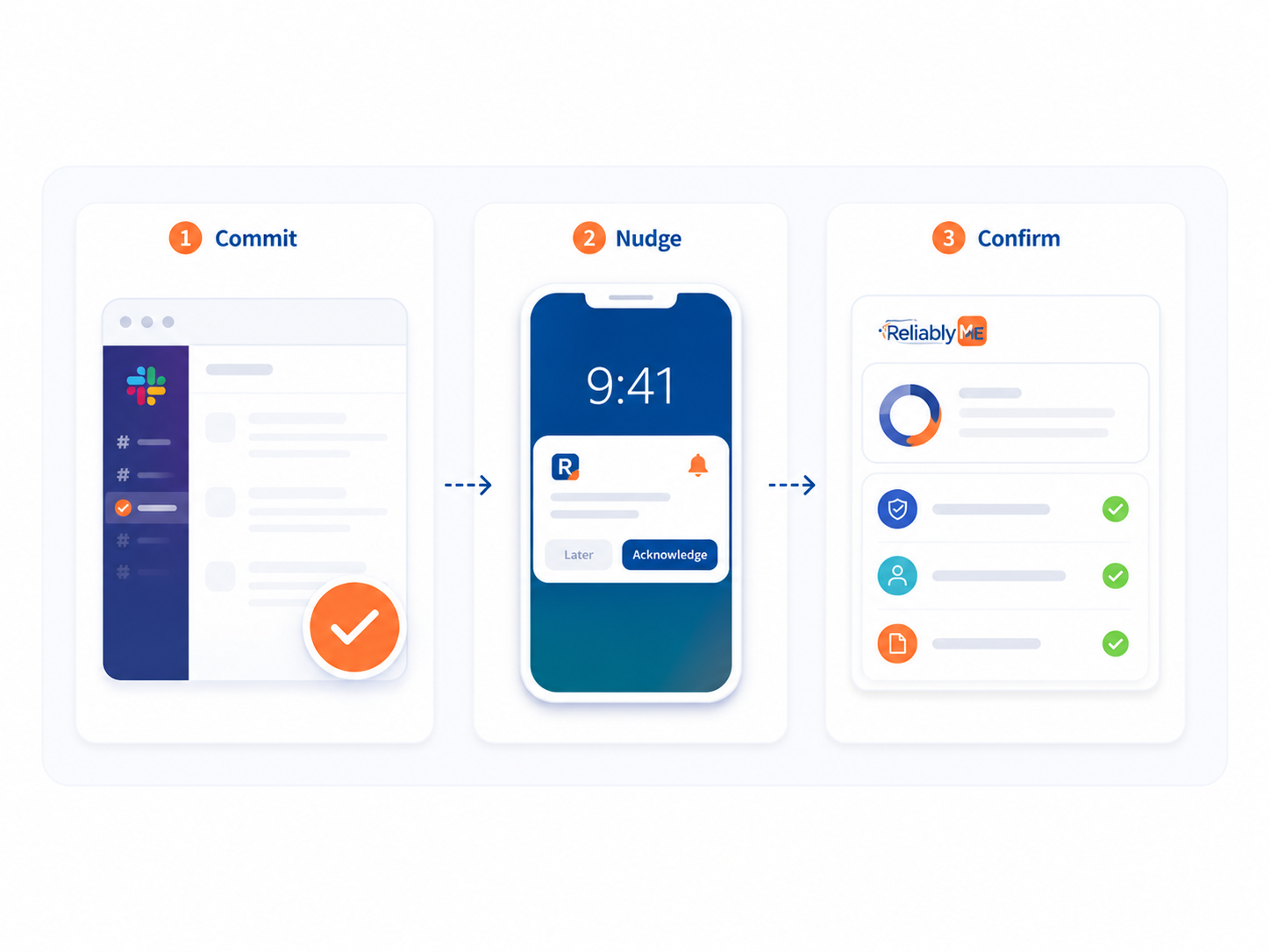
ReliablyME Follow-Through is designed to work in the surfaces where work happens, with channels confirmed for each pilot, while TECP is an architecture preview for governed AI execution.
Existing ReliablyME integration
CommitBot on Slack
Powered by ReliablyME
This describes the ReliablyME product, not ReliablyWE integration availability.
- Commitments accepted in-channel
- Follow-up delivered where work happens
- Lightweight evidence trails for follow-through
- The same review and evidence standards as the rest of the platform
Broader platform applications across three buyer contexts.
Beyond the two primary buyer paths, the same lifecycle runs under every journey: capture the accepted commitment, support follow-through, record evidence, and enable review. Click any tile to see who it's for, the problem it solves, and the benefits.
For OD, L&D, coaching, and behavioral-health leaders extending change beyond the workshop. Your OCM methodology defines the intended outcomes and behaviours — ReliablyME turns them into observable, committed, and evidenced follow-through.
For program, project, vendor, and operations leaders who need follow-through on commitments across teams.
For compliance, QA, safety, security, and food-manufacturing leaders proving corrective actions take hold on the floor.
Design goals and reviewable results
Measurable follow-through
Assess whether the agreed change carried into the workflow, using evidence associated with the commitment.
Bounded authority for AI actions
TECP is designed so agents act only within signed, revocable scope, with a durable receipt for each governed action.
Sponsor-ready proof
Reviewable evidence packs prepared for leaders, finance, and governance teams to assess. Audit suitability is assessed against applicable requirements by authorized reviewers; no result is guaranteed.
What ReliablyME is not
Not a generic reminder app. Not a habit tracker. Not a task tracker. Not surveillance, and not behavior scoring.
ReliablyME Follow-Through is the authority, commitment, and evidence layer for people and teams, with proportional evidence and descriptive rather than punitive signals. TECP is the separate governed-execution layer for policy-bounded, human-authorized AI execution. AI agents hold no independent organizational authority.
Start with one workflow
Identify one recurring handoff: the people involved, what counts as done and the evidence needed to judge the result. Product capabilities, integrations and data arrangements are assessed for that proposed scope.